[Position Filled] – Ph.D. position in renewable liquid hydrogen and hydrogen-carriers
Supervisor: Dr. Luca Mastropasqua
Contact: luca.mastropasqua@wisc.edu
This position has been filled – Please check back soon for more!
Research Motivation
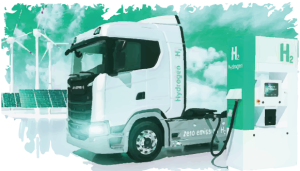
Road and maritime freight are sources of local emissions (especially diesel-connected PM, NOx and SOx) and global climate-altering emissions (CO2, CH4). The health and economic impacts of climate change and local air pollution produced by freight increasingly exacerbate inequalities and social injustice. Moreover, the rising costs of fossil fuels and geopolitical consequences of energy dependence call for an urgent transition to other energy resources to power the freight industry. Zero-emission freight infrastructure is critical and must be developed in a capillary way. To decarbonize and eliminate pollutants emitted from road and maritime freight we need renewable fuels and energy carriers like hydrogen, ammonia, and methanol. Distributed hydrogen generation systems, modular hydrogen liquefaction and storage, as well as dispensing units are some of the components needed to reach zero-emission freight infrastructure. Renewable energy sources, like wind and solar, must also be integrated to ensure a true 24/7 renewable hydrogen production.Summary
The HERD Lab at the University of Wisconsin–Madison invites applications for a funded Ph.D. student position to investigate the thermodynamics and electrochemical fundamentals of renewable hydrogen and ammonia production, liquefaction, storage, and distribution, towards the development of hydrogen refueling stations for heavy-duty trucks. More specifically, the Ph.D. work will include:- Developing polarization and impedance electrochemical models to study polymer electrolyte membrane (PEM) and solid oxide electrolysis cells (SOEC) for hydrogen and ammonia production
- Scaling-up cell models to stack and process system design simulations using commercial and in-house built models
- Discover novel thermodynamic and electrochemical cycles for distributed and modular hydrogen liquefaction
- Test and characterize the performance of electrolysis cells, stacks, and cryogenic cooling systems in the laboratory
- Perform techno-economic analyses of the integrated system design with renewable energy sources
Qualifications
Preferred qualifications:- Passionate about scientific research, sustainability, and energy
- Hold a degree in mechanical/chemical engineering with a focus on electrochemistry, energy conversion and storage, and process integration
- Have experience with electrochemistry, fuel cell and electrolysis technology, energy systems integration, and hydrogen liquefaction systems
- Have laboratory experience, or be comfortable in designing experimental methodologies, collecting, and analyzing data
- Have experience with energy and chemical plants process simulation software (e.g., Aspen Plus, Aspen HYSYS, gPROMS)
- Have experience with developing numerical simulation codes using diverse programming languages (e.g., Python, Matlab, R, C++, Fortran)
- Willing and excited to work in teams
- Comfortable public speaker to disseminate their research and communicate progress to their peers
- Excellent writer of scientific reports and peer-reviewed journal publications
- Excellent organizational and interpersonal skills
- Adept at learning new technology and/or software
- Ability to creatively solve problems and work independently and proactively
Tuitions and Stipend
The selected applicant will be appointed as a Graduate Research Assistant with a stipend in the range $29,000-$32,000 per year plus health benefits and tuition remission.How to Apply
Interested students should submit an application to the Mechanical Engineering Graduate Program within the UW–Madison Graduate School. Prior to applying, interested students are strongly advised to e-mail Dr. Luca Mastropasqua at luca.mastropasqua@wisc.edu with the following information: 1) a CV, 2) a one-page personal statement describing your scientific interests and career objectives, 3) unofficial transcripts, and 4) contact information of three references. Review of applications will begin immediately and will continue until the position is filled. Before applying to the UW–Madison Graduate School, please learn more about the application process, funding, requirements in the Guide 2022-23 Mechanical Engineering Ph.D.University and Community
The University of Wisconsin–Madison (Founded: 1848) is a public land-grant university and major research institution. Our students, staff, and faculty engage in a world-class education while solving real-world problems. With public service — or as we call it, the Wisconsin Idea — as our guiding principle, we are creating a better future for everyone. UW–Madison has been ranked 38th overall and 10th among public institutions (both in three-way ties) in U.S. News & World Report’s 2022-23 rankings of best colleges. Total student enrollment is 48,000 of which approximately 14,000 are graduate and professional students, and there are over 24,232 between faculty and staff. UW–Madison has a strong culture of collaboration across fields, and the selected graduate student will interact with researchers from diverse fields, including chemical engineering, material science, and environmental engineering. UW–Madison is an exciting place to learn and conduct research! The city of Madison ranks as one of the most attractive places in the U.S. to live and work. For information about the campus and city, please see link.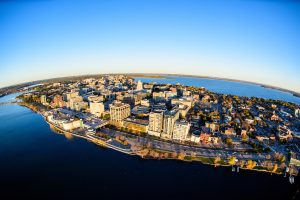
Lake Mendota and Lake Monona, along with the downtown Madison Isthmus and Wisconsin State Capitol, are pictured in an early morning aerial taken from a helicopter on Oct. 23, 2018. This photograph was captured with a fisheye lens. (Photo by Bryce Richter /UW–Madison)